

Emergency Housing for Veterans: Who to Call and What to Expect
Your lease may have ended, your home may no longer feel safe or you may have nowhere to sleep tonight.
Emergency housing for veterans exists, but support is spread across several services. This guide explains who to call, what help may cover and where the limits sit.
Start Your Claim Today
Get expert help with the entire claims process and secure the entitlements you deserve. With zero upfront fees, you only pay for successful claims.
In this Article:
What Emergency Housing for Veterans Really Means in Australia
The first thing to know is that DVA is not usually the service that gives you a bed for the night. Outside residential care, housing help is generally handled through referrals, local homelessness services and crisis support providers.
DVA may still be part of the picture. It can check what DVA support you already receive, connect you with relevant services and help identify whether case management is needed.
That means emergency housing support is not one single doorway. It depends on where you are, what has happened, whether you are safe tonight and what accommodation is available near you.
When You May Be at Risk of Homelessness
You do not need to be sleeping rough before asking for help. You may be at risk if you have nowhere stable to stay, are relying on a couch or are staying somewhere unsafe because you have no better option.
A relationship breakdown, sudden loss of income, illness, injury or family violence risk can also make your housing unstable.

Who to Call First When Your Housing Falls Through
There is no single veteran housing hotline that solves every situation. The right first call depends on whether you are safe, whether it is after hours and whether you need housing, mental health support or both.
Open Arms for After-Hours and Weekend Support
Open Arms can be a useful first call when the crisis happens at night, over a weekend or when your housing situation is affecting your mental health.
Eligibility depends on service history and family connection, so call and ask them to confirm whether you can access support. You do not need an accepted DVA condition before you ask what help may be available.
DVA During Business Hours
During business hours, DVA may be able to help connect you with local homelessness services and check whether any DVA support is relevant to your situation.
Call 1800 VETERAN during weekday business hours. For non-urgent follow-up, you can also use MyService or visit a Veterans’ Access Network office.
When You Are Not Safe
If there is immediate danger, call 000 first. If family or domestic violence is involved, contact 1800RESPECT on 1800 737 732. Open Arms can support mental health and wellbeing, but specialist family and domestic violence services are still important where safety is the issue.
Open Arms Crisis Accommodation Support and Its Real Limits
Open Arms Crisis Accommodation Support may provide eligible clients with up to three nights of short-term accommodation and mental health support. Access is subject to suitability criteria and is not automatic.
Open Arms requires clients seeking this support to engage in Care Coordination. The care coordinator can help address the issues behind the crisis and refer you to other services where needed.
Open Arms is not a homelessness provider, but it may provide emergency accommodation and referrals to specialist services. I would treat those nights as a short bridge, not a housing solution.
Use the time to get a specialist homelessness service working on your case. Keep making other accommodation requests while that support is underway.
The DVA Crisis Payment Is Money, Not a Bed
The Crisis Payment is often misunderstood. It may provide a one-off payment in specific crisis situations, but it does not arrange accommodation for you.
That means it should not be treated as an emergency housing service. If you need somewhere to sleep tonight, contact Open Arms, DVA during business hours and your state or territory homelessness service.
How Much the Crisis Payment May Be
The amount is linked to one week of the Service Pension rate. At 1 July 2026, the listed amount was $600.45 for a single person and $452.60 for a member of a couple.
DVA reviews these rates during the year, so check the current figure before relying on an amount.
The payment also has limits. DVA looks at financial hardship, liquid assets and whether the same circumstances have already been used for a previous payment.
When You May Qualify and How to Apply
Eligibility depends on the pathway you apply under. This may include certain extreme circumstances, family and domestic violence situations or release from lawful custody.
There are strict timing rules. In many cases, you need to claim within seven days of the event or circumstance.
The form depends on the reason for the claim. D0568 is used for domestic violence or extreme circumstances, while D0567 relates to release from prison or psychiatric confinement following a charge.
The Crisis Payment does not cover every eviction or housing problem. Ask DVA to check your eligibility before assuming it applies.
Why You Should Work More Than One Door at Once
I need to be honest about this part. AIHW data shows that accommodation needs are not always met.
In 2024–25, homelessness agencies assisted around 1,500 clients who identified as current or former ADF members. Almost two-thirds, or 960 clients, needed accommodation, and 510 received it.
Around 290 clients received neither accommodation nor a referral to another agency. That is why we recommend making several requests at once rather than waiting on one service.
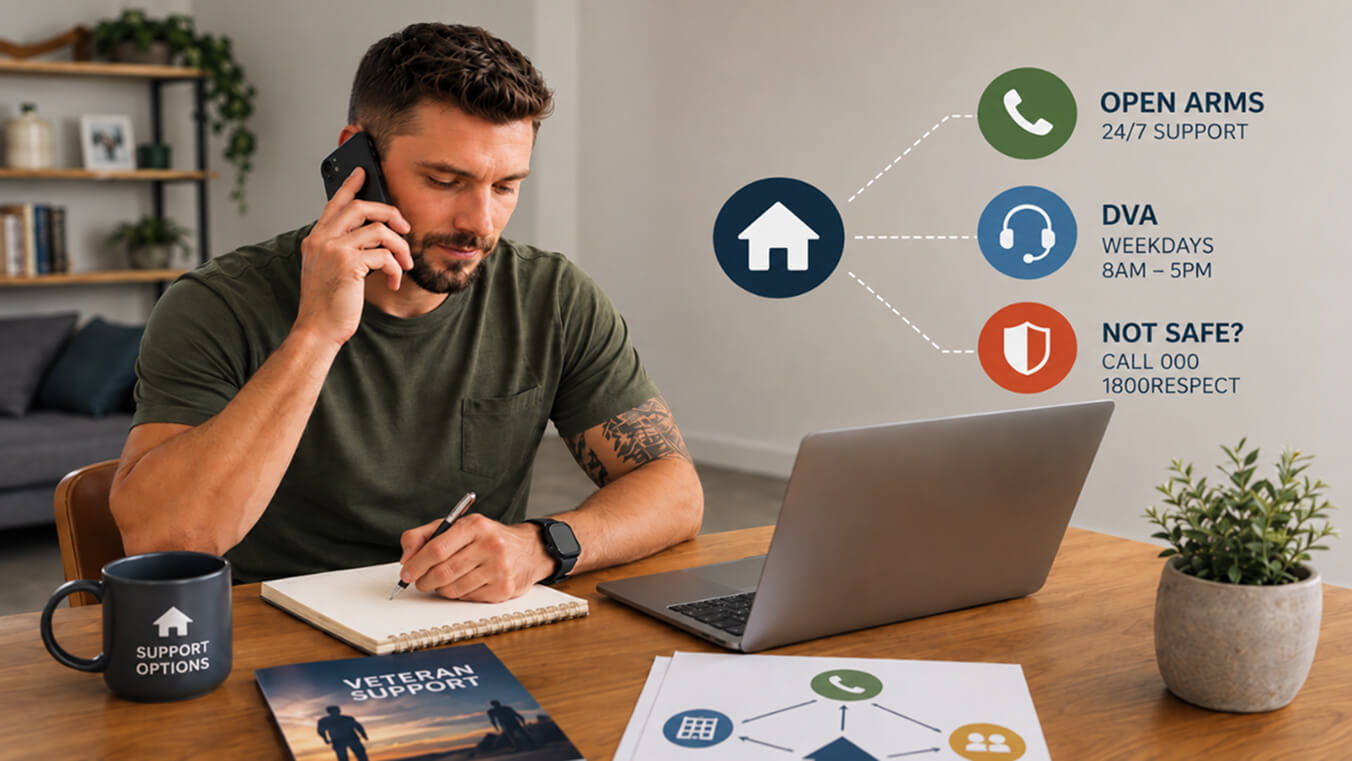
Ring Open Arms and ask DVA for a local referral. Contact your state or territory homelessness service on the same day.
State and Territory Emergency Housing Contacts
State and territory services manage much of the local emergency accommodation system. The right contact depends on where you are, the time of day and whether you need crisis accommodation, housing intake or referral to another local provider.
Instead of relying on one pathway, contact your state or territory housing entry point, call Open Arms if the crisis is happening after hours and ask DVA whether a local homelessness referral can be made.
DVA lists state and territory contact options on its homelessness support page. Use that page to check the contact for your location, because phone numbers and intake arrangements can change.
The Veterans’ Acute Housing Program funds selected organisations that provide crisis housing, transitional housing or specialist homelessness support. It is not a direct application pathway where a veteran applies to DVA for a bed.
The DVA program page lists funded organisations and projects rather than a direct application process for veterans. Local availability depends on the provider and project operating in your area.
If your family is in crisis but immediate housing is not the issue, the Acute Support Package may fund approved short-term services through a support plan. It does not provide cash payments and is not a primary emergency response. Do not use it in place of urgent housing or safety support.

How a DVA Claim Fits Into Longer-Term Housing Stability
Emergency accommodation may give you a few safe nights, but longer-term stability may also depend on income, treatment and local housing support. If a service-related condition contributed to your housing problems, an accepted DVA claim may open access to certain payments or services.
Payments That May Support Housing Stability
Incapacity payments may compensate for economic loss when an accepted service-related condition reduces your ability to work. Veteran Payment may provide interim income while DVA assesses an MRCA mental health claim.
For Veteran Payment, you must have lodged an MRCA mental health claim and be unable to work more than eight hours a week, among other criteria. Rent Assistance may apply if you receive a qualifying means-tested DVA payment, live in Australia and pay eligible private rent.
We recommend checking each payment against your own circumstances. An accepted condition does not give you automatic access to every entitlement.
How the Claim Process Fits In
From 1 July 2026, all new compensation and rehabilitation claims are determined under the improved MRCA. Claims lodged before that date remain under the earlier system, while most existing payments continue under grandparenting rules.
An initial liability decision states whether DVA accepts your condition as service-related. DVA then completes a needs assessment before compensation can be paid.
DVA reported in April 2026 that MRCA initial liability claims averaged about 120 days over the previous 12 months. That figure covers only the initial liability stage and does not include a later permanent impairment claim.
In my experience, the full permanent impairment claims process often takes around two to three years from the initial claim to the final decision. It may take longer if DVA needs further evidence or clarification.
A claim will not house you this week, but accepted conditions may support longer-term stability through eligible treatment, rehabilitation or income support. Our guide to housing support programs available to veterans covers longer-term options. My DVA financial hardship guide explains other support that may apply when money is the main pressure.
What We Check After the Immediate Crisis
Once you have somewhere safe to stay, we check whether a service-related condition contributed to a loss of work, income or day-to-day capacity. We also check the claim stage, accepted conditions and whether the available medical evidence explains that impact.
We then identify which claim evidence or DVA entitlement needs closer review. Veterans First Consulting does not arrange housing or emergency accommodation, but we can help prepare the claim and supporting evidence for DVA to assess.
Support If Things Feel Overwhelming Right Now
Losing your housing is more than a practical problem. The stress can hit hard. These services offer free and confidential support:
- Open Arms, Veterans and Families Counselling
- Safe Zone Support
- ADF Mental Health All-hours Support Line
- Lifeline
- 1800RESPECT
You do not need a DVA claim or referral to contact Safe Zone Support, Lifeline or 1800RESPECT. Open Arms and the ADF Mental Health All-hours Support Line have their own eligibility rules.
Getting Through Tonight, Then Moving Forward
For urgent housing support, contact Open Arms, DVA and your local homelessness service today. Use the most appropriate contact above based on the time, your location and whether you are currently safe. Once your urgent needs are being managed, we can assess whether a service-related condition may support a DVA claim. Veterans First Consulting has supported thousands of veterans through the claims process. Contact the team when you are ready for claim support.
Written by
START YOUR CLAIM
Book a Free Call
Join more than 10,000 veterans in getting the support they deserve. Leave us a note and our experts will be in touch shortly to discuss your new claim or claim reassessment.
Zero upfront fees – only pay for successful claims
10,000+ veterans served – we know what we're doing
Australia's largest DVA advocacy group
Explore Related Articles

A Comprehensive Guide to Veterans Housing Programs and Support

Rental Housing for Veterans: DVA Support, Rent Assistance and Your Entitlements
